
A Game About Living All Your Best Lives At Once
Review: Fantasy Life i: The Girl Who Steals Time Fantasy Life i: The Girl Who Steals Time – the sequel to the 2015 3DS smash hit Fantasy Life – is a game that does not force you to make choices that will define your playthrough. At the beginning of the game, you’re asked to pick […]
Review: Fantasy Life i: The Girl Who Steals Time
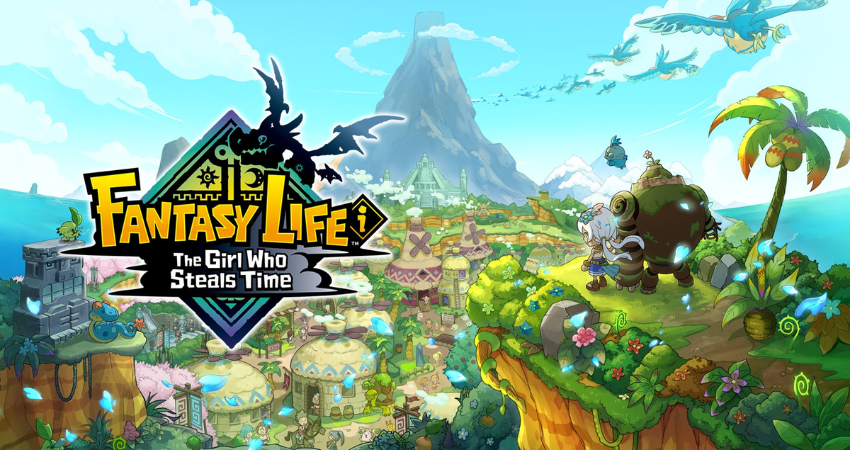
Fantasy Life i: The Girl Who Steals Time – the sequel to the 2015 3DS smash hit Fantasy Life – is a game that does not force you to make choices that will define your playthrough. At the beginning of the game, you’re asked to pick one of 12 different “lives” – you could be a sword-wielding Paladin, a hammer-wielding blacksmith, a keen-eyed angler, and so on (two more lives unlock during the story, too). After going through the initial training, you can jump right into the wider adventure the game offers up – or you could pick a new life and immediately learn something new.
Within ten hours of starting Fantasy Life i, I was using my blacksmithing abilities to build new weapons that I could use as a paladin or a mercenary, donning my chef hat to cook up tasty meals to sustain my ever-growing party with the vegetables I’d cultivated as a farmer. My skills as a miner and woodcutter let me gather resources to strengthen my tools, and as a carpenter I used some of them to better furnish the house I’d acquired. And still, more lives stretched out ahead of me, each of which promised to slot into my ever-expanding routine. It’s a really excellent system, one that gives you a huge degree of control over how you experience it.
Fantasy Life i is a game that is at times relaxing, which has very chilled vibes, but is also huge and full of tasks to complete. It sometimes feels like several other games stuck together, with a story and structure that spans different times, places and play styles. It can get overwhelming – there’s just always a lot to do, to keep track of – but the key, you’ll soon realise, is to learn when to take a breath. Fantasy Life i rewards players who take their time to enjoy everything the game has to offer – there’s an awful lot to love in here, and it’s up to the player to uncover all of it as they jump between different locations and playstyles.
It sounds more convoluted than it is in practice, but it’s really up to you how you want to tackle all the different tasks on offer. You can pick a few lives and focus on finishing the main story, using merchants to upgrade your equipment instead of making your own, and you can push aside a lot of the homesteading elements if you want. But the best approach, I found, was to jump into the game world and see what I felt like doing in any given session. Did I want to learn a new life? Did I want to explore the vast contingent of Ginormosia in the present day, battling monsters and unlocking new parts of the map? Did I want to complete the next primary objective and see what happened next in the story, or would it be better to redecorate my house?
Whenever you journey you’ll meet characters who give you new objectives, and every life has its own set of goals. Moving through Fantasy Life i and completing tasks will usually progress multiple paths at the same time, and often in completing a task you’ll uncover other potential objectives across the way. This is a game that keeps growing bigger, and often I’d find myself referring back to the pause screen guide to keep track of things – for the first five hours I completely forgot that each life had its own upgradeable skill tree, for instance, and there are mechanics explained early on that are easy to forget about entirely.
Yet the moment-to-moment gameplay in Fantasy Life i is actually quite simple. Many jobs are represented through straightforward minigames, and combat isn’t complex, no matter which life skillset you’re using. I found that I only ever collapsed during fights if I took on an enemy that was at far too high a level, and even then it’s usually easy enough to escape. The real challenge comes from finding the right balance – knowing when to focus on leveling up your lives, when it would make sense to pursue a different goal for a while, and deciding how to play the game each time you jump in. If you want to, you can put all your energy into becoming a master tailor who can make any outfit, or a fishing master – those are perfectly valid ways to play.
Fantasy Life i is a huge game that feels complicated when you try to hold it all in your head at once. When the controller or console’s in your hand, though, the experience of actually playing it feels very natural, even calming. It’s a wonderful game, one where each of the hundred different threads you can pick at feeds into several of the other threads in your ever-expanding to-do list – it really does give you the feeling of pursuing multiple different fantasy lives at once. Just don’t be afraid to pause sometimes, take stock, and think about what you want to get out of the experience: odds are you’ll be able to get it.
Fantasy Life i: The Girl Who Steals Time is available now on PC, PS5, Xbox and Nintendo Switch/Nintendo Switch 2. A Nintendo Switch copy was provided by the publisher.
James O’Connor has been writing about games since 2008. He is the author of Untitled Goose Game for Boss Fight Books.
About the Author
Related articles

This Great Gaming Series Loses Itself in the Finale
Review: Life is Strange Reunion In 2015, developer Don’t Nod released the first episode of Life is Strange (back then, episodic adventure games were all the rage). Over the course of that five-episode first season, players would grow to love photographer protagonist Max Caulfield and her anarchist friend Chloe Price. The game was filled with […]
5000 Years of Civilisation Laid Bare
Review: Goliath’s Curse: The History and Future of Societal Collapses, Luke Kemp, Penguin In his book of collapsology, Luke Kemp turns much received wisdom about barbarism and civilisation on its head. It’s the product of an enormous amount of research and contemplation, and it’s a goliath of a book, partly because he tends to repeat […]
Questioning Christianity Today
Review: Don’t Forget We’re Here Forever, Lamorna Ash, Bloomsbury We hear much about simultaneous decline and revival in Western Christianity but there isn’t another book on contemporary Christianity quite like Lamorna Ash’s. The writer of a previous book on the Cornish fishing industry, in this new book she likewise takes a very personal approach, immersing […]