
Why AI Keeps Making Jesus Look Like an Influencer — and Why It’s on Us
Scroll through Facebook or Instagram these days and you’ll likely run into AI-generated images of Jesus. But these aren’t the gentle, humble portraits from Sunday school walls. Instead, AI Jesus often shows up ripped, rugged, and oddly ready for a men’s fitness magazine — complete with chiseled jaw, flowing hair, and sometimes even tattoos or […]
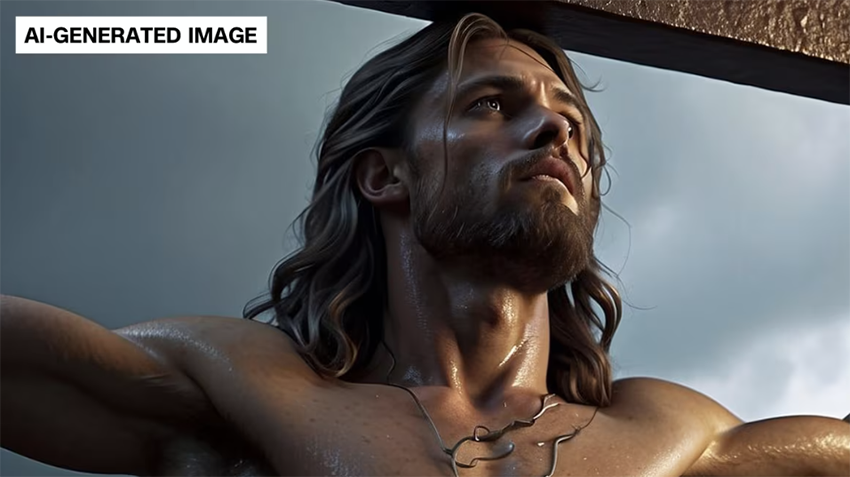
Scroll through Facebook or Instagram these days and you’ll likely run into AI-generated images of Jesus. But these aren’t the gentle, humble portraits from Sunday school walls. Instead, AI Jesus often shows up ripped, rugged, and oddly ready for a men’s fitness magazine — complete with chiseled jaw, flowing hair, and sometimes even tattoos or bulging biceps.
At first glance, it’s easy to blame the technology itself. But the story goes deeper. And, as it turns out, we might be part of the reason why AI keeps creating this kind of image.
Making religious figures look “better” than real life isn’t new. Art historian Brenda Sanderson explains that ancient Greeks and Romans already depicted their gods as strong and beautiful. Christians followed suit, turning Jesus into an ideal figure that reflected spiritual power and health.
From Michelangelo’s muscular figures in the Sistine Chapel to romantic paintings of Mary Magdalene draped in flowing hair, artists have always taken creative license. Sometimes they pushed the limits, as in 19th-century Belgium, when a statue of the devil was removed from St. Paul’s Cathedral for being “too sublime” and possibly distracting worshippers.
Even today, the debate continues. Earlier this year, Spanish artist Salustiano García Cruz faced criticism for painting what some saw as a “sexualized” Jesus.
So it’s not shocking that AI, trained on thousands of these idealized works, picks up on the same patterns.
Generative AI models learn by studying huge amounts of images and art. Christopher Framer, a programmer who works with AI, says the output depends both on what the AI is trained on and the words people use to prompt it.
For example, adding words like “strong” or “powerful” to an AI prompt can shift an image from serene to superhero-like. And because many social media posts chase engagement, creators often add dramatic details that get attention: muscles, heroic poses, or even battle scenes.
But Framer points out that these AI systems don’t actually “know” Jesus. They just recognise patterns. And as more people share rugged AI Jesuses, those images become part of the data that future AI learns from. The result? A feedback loop that keeps producing the same style.
Many AI Jesus images online don’t come from serious art projects or religious communities. They often appear on spammy Facebook pages and clickbait sites, bundled with hashtags, merchandise links, and ads. It’s less about faith and more about harvesting likes, shares, and ad money.
People scrolling by might not notice or care that the images are AI-made. A quick “Amen” and share feels harmless. But collectively, it keeps the cycle going.
It’s worth asking what these AI images say about what we want from faith — and from Jesus. The Bible doesn’t describe Jesus as conventionally handsome. Yet, our prompts and our likes help create a version of Jesus who’s more superhero than suffering servant.
In the end, AI isn’t deciding how Jesus looks. We are. And what gets shared and liked the most reveals something about what we value — even if it’s just an idealized, Instagram-ready saviour who fits neatly into a scrollable feed.
About the Author
Related articles

The Church’s Next Digital Reformation May Already Be Here
When people talk about artificial intelligence and Christianity, the conversation often swings between panic and prophecy. Either AI is about to destroy authentic faith, or it will somehow usher in a new spiritual awakening. But according to Bobby Gruenewald, the more uncomfortable reality is that technology and faith are already inseparable. That observation matters because […]
Why I Deleted Social Media
A Personal Reckoning with the Algorithm On 25 April 2026, I deleted my accounts on Facebook, Instagram, Snapchat, BlueSky, X/Twitter, TikTok, and LinkedIn. Not deactivated. Deleted. The data, the followers, the years of curated digital existence: gone. I kept Substack for long-form writing and YouTube for my podcast and teaching videos. Everything else I let […]

Andor’s Prescient and Urgent Reflection on Truth
Warning: This article contains spoilers for Andor, Rogue One and Star Wars: A New Hope. Andor has wrapped up its second and final season. The Disney Star Wars television show follows the adventures of Cassian Andor as he participates in the rebellion against the Galactic Empire after Imperial stormtroopers destroy his entire tribe as a […]